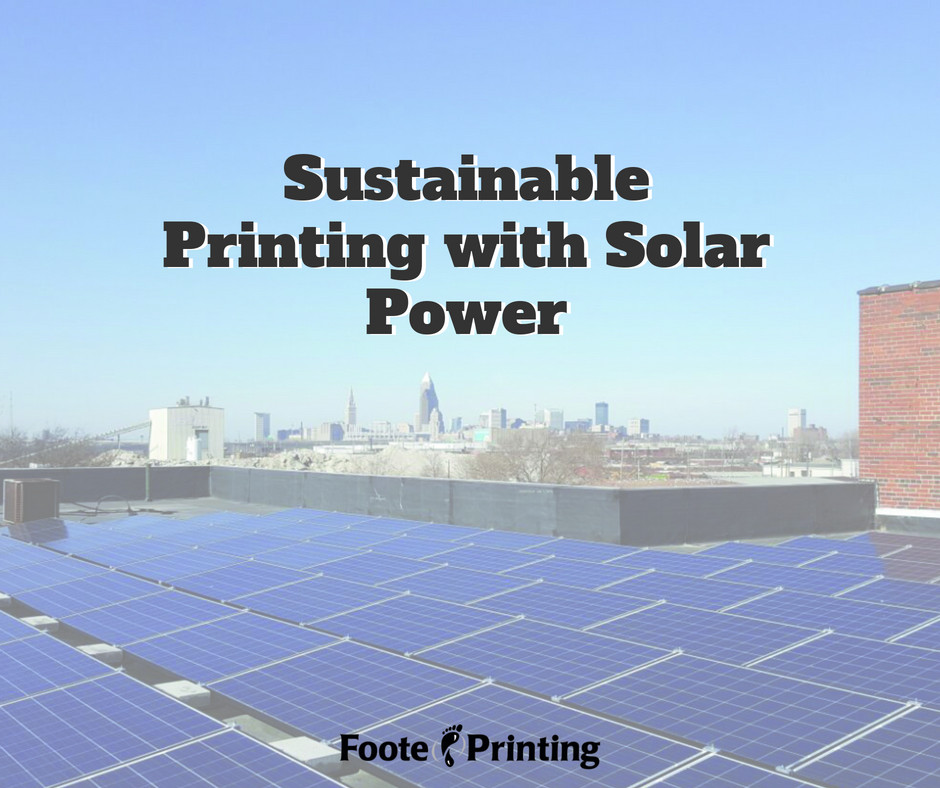
At Foote Printing, we try to be as green as possible because we care about our impact on the environment. We understand that our industry can create a lot of unnecessary waste. This is why we have resolved to take every possible action in order to reduce our carbon footprint. In fact, our most successful proxy was making the switch to solar power!
How Foote Printing Has Gone Green
Solar Powered
We knew we wanted to switch to a renewable alternative energy, but we didn't know which one would work out best for us. Initially, we thought about installing a wind turbine as we all know Cleveland is a windy city! Sadly, that wasn't a viable option for us as we had nowhere to put the turbine.
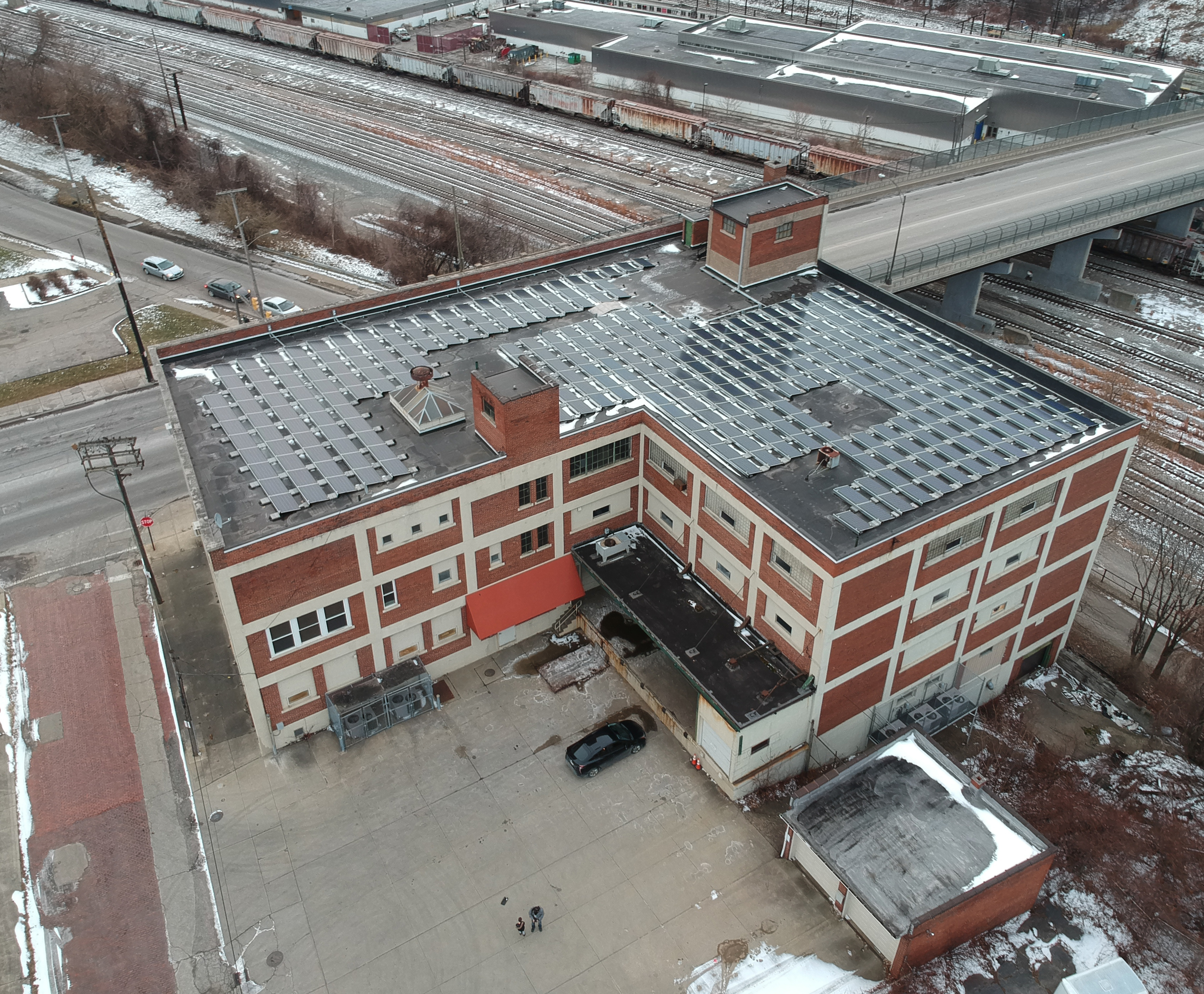
Instead, we opted for solar energy. We installed 305 solar panels to our business which cover our entire roof. Covering the whole roof of our shop are 305 solar panels which produce enough energy to power about 80% of our printing! Of course, this can vary from month to month depending on how much sun we see each month. For example, in February we typically don't get much sun, but we also aren't using much electricity because we don't have to worry about running our A/C as we do in the summer months. So, it really works out well for us!
Moreover, solar energy is extremely cost-effective. Though the initial installation can be costly, it pays off with a lower electricity bill each month.
Other Ways We Reduce Our Carbon Footprint
Solar power is definitely our largest and most successful effort to go green; however, we also commit to other ways to preserve our environment. We also recycle 99% of the paper and ink supplies that go through our shop.
As a result of our commitments to go green, we have reduced our carbon footprint to be similar to that of an average household, and we are very proud of that!
If you are someone who cares about the environment and you need to have anything printing, no matter how big or small the job is, print with us as we share your passion for sustainability. Moreover, if you have any questions about our solar panels and how they help us reduce our footprint, then please, contact us at Foote Printing today!

Your brochure has only a few seconds to earn a glance in the mailbox, a click to your website, or a call to your team. Make those seconds work.
At Foote Printing, we help clients turn brochure printing into real responses. I’m Michael Duhr, and our team guides you from fold choice and layout to smart mailing that protects your budget. Below are the practical insights we share every day to help your brochure convert.
Start With Purpose and a Clear Story
Before you pick a fold, decide how the brochure will be used.
First touch piece that introduces your brand
Leave behind that reinforces a sales conversation
Direct mailer that needs to trigger an action fast
Then shape the content:
Lead with what you do and how to reach you
Use a single, clear call to action
Align copy and visuals to a simple story arc
Pro tip for any format: treat the front panel as a strong headline and offer. Your logo matters, but the benefit should get the first glance. Win attention, then reveal who it is from.
Choose the Right Brochure Fold
The format should serve the message and the mailing method. Here is how we think about the most effective options.
Trifold Brochure
Why we love it: Three inside panels make a natural story, part 1, part 2, part 3. If you cannot explain your business in three steps, it may be hard for readers to follow.
Mailing edge: Standard 8.5 by 11 folded to fit a number 10 envelope, often the lowest letter postage rate.
Content tip: Use the cover as a headl
Picture this. You crack open a box and hold your finished book for the first time. The cover shines, the pages feel right, and your story is finally real. That moment is why we do what we do at Foote Printing.
Your Big Idea, Made Print Ready
Authors and creators often ask the same questions when they are ready to print a memoir, a manual, or a collection. How much will my book cost to print? Which binding should I choose? How long will it take? As a shop that produces books every day, we can give you clear answers that save time and money while protecting quality.
Below are the essentials we share in every consultation, straight from Michael Duhr and our team.
What Drives Book Printing Cost
Several factors influence your budget. Share these details with us early to get a fast, accurate estimate.
Quantity. Per-unit cost drops as your run increases.
Page count. More pages mean more paper and a different binding choice.
Binding type. Saddle stitch is the least expensive. Hardcover is the most expensive.
Color vs. black and white. Full color throughout costs more than black and white or spot color.
Paper and cover stocks. Heavier or premium papers add cost and elevate feel.
Special finishes. Dust jackets, foil, and other embellishments increase unit price and lead time.
For perspective, hardcover is typically the priciest route. On many short to mid-sized runs, it can be challenging to land under eight to ten dollars per unit, depending on specs.
Binding Options and W
Nothing kills the excitement of fresh business cards or a new folder like a fuzzy logo. You hold it up, the colors pop, but the edges look soft. That cheap, blurry look is not your brand. It is a file problem, and we solve it every day at Foote Printing.
The Real Culprit: A Rasterized Logo
If your logo prints blurry, odds are you sent a raster file like a PNG or JPEG. Raster images are made of tiny squares. On a backlit screen those pixels can look fine. In digital print or offset print, those squares show up as jagged edges, especially on curves and diagonal lines. Even a small logo on an envelope can look off if it is raster and not high enough resolution.
A vector logo is different. It is built from points, lines, and curves defined by math, not pixels. That means infinite scalability and crisp edges at any size.
Raster vs. Vector, Explained
Raster: PNG, JPEG, TIFF, PSD. Pixel based, can blur when scaled, better for photos.
Vector: AI, EPS, SVG, and many PDFs. Math based, scales cleanly, perfect for logos and icons.
Yes, you can crank up DPI on a raster file, but unless the image is extremely high resolution at the exact print size, edges will still soften. Vector avoids that altogether.
Quick Ways To Check Your Logo
Zoom test: Zoom in close on a curve. If you see tiny squares, it is raster. If the line stays perfectly smooth, it is vector.
File type check: Look for. AI or. EPS. Many PDFs are vector too. PNG and JPEG are almost always raster. Photoshop files a